Monday, March 12, 2012

Homestay

A homestay is where a day is spent with a family and the volunteer helps around the house with chores, homework, whatever needs to be done.

The student I partnered with is named Kayesw Betty, and she lives in Bugonzi B. I had been in the are a few weeks before on an issue regarding a water collection system.

Each morning Betty leaves the house at 5am, walks two hours to get to school without breakfast. She leaves school around 5pm, and walks the two hours home.

From Kyetume we climb on a boda and drive over a dirt road that gets worse before it gets better. There are more holes, bumps, and gaps than there is road. The road eventually turns into a path, and my legs are so long that my knees are going through brush. Half an hour or so later the path evens out a bit and we arrive at her house.

No one is home. Mother is out herding goats and the grandmother is somewhere else. We sit down in the shade of the house and I show her photos of my family.

Jaja (grandma) Kabgera Elizabeth shows up and unlocks the front door. Inside two small calico cats run past us and then outside. There are two small couches and a table. A laminated paper with the ministry of Galilee hangs from a nail on the wall. We sit and Betty asks me to show Jaja my photos. She speaks Luganda, Rwanda and another language, so Betty translates as we flip through the photos. This was followed by a couple of albums of Betty, her family and friends.
At the end I gave her and her friend some native art design cards.

Two small children show up to visit. A book on Uganda is brought out and Betty explains a number of the photos.

The radio is turned on, but something is not working properly with it, so it is turned off. I then ask her if she would like to listen to some of my music.

Fast punk seems to hit a chord with them, Ugandan music, from what I've heard, is generally upbeat, fast, fun music.

Jaja then asks me, through Betty if I like eggs, and goes into the back. She comes back with two raw eggs to say thank you for coming to visit. I was quite touched.

Photos start here.

Wednesday, March 7, 2012

Transportation

Walking
This is very common, people will walk long distances, with great loads of things.

Bicycle
Large loads are carried via bicycle, endizi, trees, jerry cans of water.

Boda Boda
A number of years ago an influx of motorcycles arrived in Uganda. Quick, and cheap they flooded the market. The number of traffic accidents due to Boda's are very high. Due to the sudden introduction most of Uganda's infrastructure is unsuited for them. Boda drivers are quite fond of mezungus and will stop pedestrians frequently to offer rides. It is important to establish a price beforehand otherwise it will be significantly more.

Public Taxi
This is the mode of transport that I use the most. A 15 person van that has up to 19 people in it at any given time. The vans have a alternating black and white square pattern to indicate it is a taxi. A brightly lettered religious slogan is usually seen on the top of the front windshield, with one exception. Chelsea FC. A hand wave from the side of the road is all it takes to catch a taxi.
When taxis stop in villages for passengers the van is approached by meat, banana, and beverage vendors.

Special Taxi
Unmarked, unlicensed cars.

Friday, March 2, 2012

February 25-March 1, 2012

February 25

There is no power, so I taxi into Masaka after hanging my clothes to dry.
As I get back it starts to rain. Torrential downpour for the rest of the evening.

February 26

We visited a village called Kajjalubanda to participate in a medical camp. The goal of the camp is to make medical visits affordable and convenient for those who need it in rural areas.

A doctor comes from outside, and volunteers measure weight, check temperature, record medical history, the doctor consults and a nurse administers prescriptions.

This is about 5 times cheaper than visiting a clinic or a doctor, not including the trip to town, this is also one of the benefits of having a clinic at Hope Academy available to the public.


A child, too small to ride a bike normally, puts his leg through the middle to reach both pedals, avoiding the seat entirely. Other children run by, pushing sticks with wheels screwed into them, while others use sticks to push car tires. A child kicks a deflated soccer ball, while another kicks an empty pudding cup.

February 28
Health camp at Bugonzi C/U primary. We drove far off the main road to speak with Primary 4-7.

Bugonzi B, we attend a village meeting regarding concerns over a planned water accumulation project. The goal is to build a water collection container in Bugonzi A to distribute water to the locals. The major concern was where the container would be located. The nearest water sources aside from this are a local dam, and a well, both located a distance away. In most cases in the survey I read most water is collected by younger, able bodied people, but in some cases children as young as five, or the elderly go fair distances to carry jerry cans of water.

February 29th: Aka Leap Day
We dug up the garden where we were building a kitchen.

I spoke with the Senior 1s and 3s about starting a year book.

On my way home from Kyetume a group of children had left school across the street from me, running across the street to catch up to me. They did not say anything to me at first, and because my stride is so long they had to run every once in awhile to catch up.

March 1

The morning's endeavor consisted of a trip far off the main road to build dry stands.

March 2
The driver of the boda taps the sticker of the Virgin Mary covering his mirror as he puts on his helmet. The road is steep and the dust cloud straight ahead gets bigger and envelops us. The incline turns from pavement to dirt and rock as the sunlight breaks through the bottom of the clouds. A gorgeous orange and pink illuminate the horizon as the driver stops in Chabacuza. A grey twilight quickly follows as I switch to a taxi.

I find out that the pig at home has been eating the baby ducks. There is now only 1 out of 8 baby ducks.

Tuesday, February 28, 2012

February 24, 2012

We visited Kyetume primary, a protestant school of about 700 students, and 12 teachers. The presentation was on Health and Leadership.

On the way home I sat outside a store after purchasing a cold beverage. The store operator comes out and starts pouring liquid from a can into a coca cola bottle. I suddenly realize that the store is also a gas station.

Later on Kirsten insists on getting something packaged. A fifteen minute walk/ her singing about the joys of processed food leads us back to Kyetume. I purchase some chips and cabbage from a girl cooking at a fire outside.

February 25. There is no power, so I hang up my laundry to dry and head into Masaka.
A torrential downpour falls, and my laundry remains wet til the next day.


Below are photos of some of the school dorms.

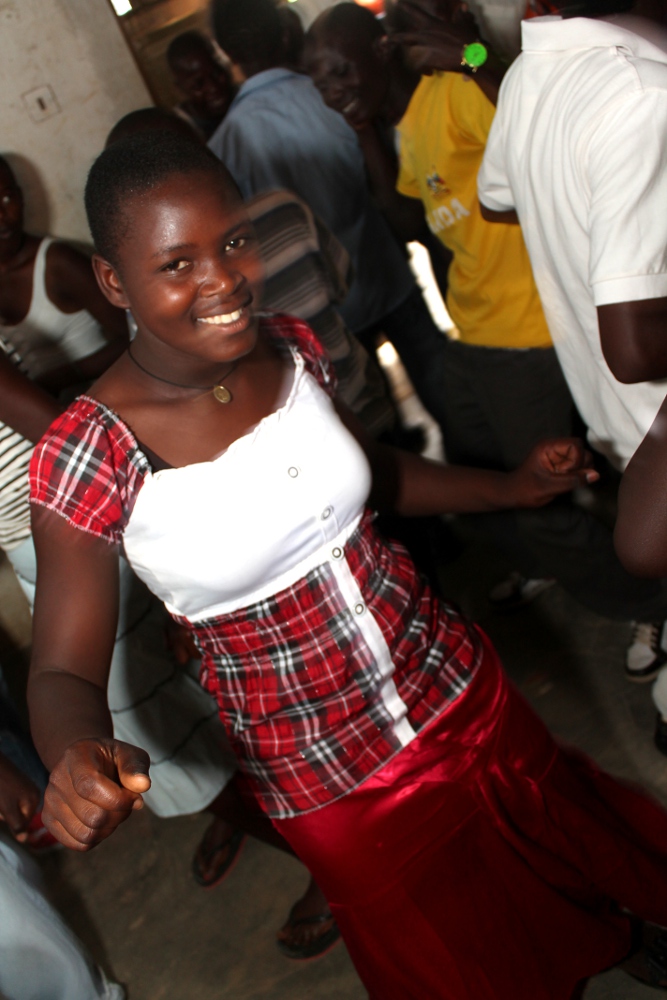
The Senior Ones finished exams on Friday, and to celebrate they hosted a dance at the school. A room was converted into a dance party. The windows were covered up, a generator was brought in to power large speakers, a dj used a laptop to pump dance music throughout the school. Bottles of soda were sold, and juice was given out by volunteers.

Saturday, February 25, 2012


Thursday, February 23, 2012

The project officially started on December 29th, 2012 as the first step to self sustainability. The project was facilitated by a team from St Benedicts University. John and Cole came to URF to help build coops, as well as fundraise to purchase approximately 600 chickens. The goal is to reduce donor dependency, and to help develop smaller projects with income from sale of the eggs. The end of the year target is 1000-1500 birds producing 50-100 eggs a day.

About ten feet from the edge of the building where I sleep is a chicken coop. A wooden frame coated in metal panels. The interior is coated with chicken wire for obvious reasons. Wooden poles criss cross over wooden feeding containers. Around 524 chickens occupy the room, and when the power goes out they huddle together.

The rooster likes to wake me up at 5am, and on those mornings where I do get up I like to venture out in the darkness and see these birds.